In this article
Old villa pools are a category of their own. Many were built when waterproofing products and methods were simpler than today, have had several quick fixes over the years, and some have changed owners so nobody knows their exact history. When an old villa pool starts leaking, the answer is rarely just sealing a crack. It is a considered decision about the whole waterproofing system. This article explains why these pools leak, how the source is found, the difference between local and full waterproofing, and how to choose a system that handles Riyadh's climate.
Why old villa pools leak more
- Aged waterproofing that has lost flexibility and cracks under repeated heat cycles.
- Old pipework with weaker joints than modern systems.
- Minor soil settlement around or under the pool, appearing after years and cracking the shell.
- Layered repairs with different products that do not bond well to each other.
- New tiles laid over old ones, adding load and hiding original cracks.
- Long periods of neglect, such as standing empty, exposing layers to sun and dryness.
Each factor may be minor alone, but together they mean an old pool needs a full assessment. For a wider view of your pool's condition, see signs an old villa pool needs renovation.
Finding the source in an old pool
- Confirm the loss by comparing the pool with a bucket of water in the same conditions.
- Pressure test the pipes line by line, as old pipes are a frequent source.
- Visual and tap checks on tiles to map hollow areas and cracks.
- Dye testing around fittings and previous repairs.
- Structural assessment if there are structural cracks or settling paths.
The key outcome is not only where the leak is, but whether the problem is one point or generally weak waterproofing. That decides the treatment.
Local or full waterproofing?
| Situation | Usual treatment |
|---|---|
| One leak point with sound waterproofing around it | Local waterproofing overlapping the sound area |
| Leak around a light or return fitting | Reseal the fitting and waterproof around it |
| Buried pipe leak with a sound shell | Repair the pipe without touching the pool membrane |
| Widespread hollow tiles and cracks in several walls | Remove tiles and fully rewaterproof |
| Several failed past repairs | Full system from one compatible range |
Local work costs less time and money but only succeeds when the rest of the membrane is healthy. Otherwise it becomes an endless series of patches, each revealing new weakness next to it.
Stages of full waterproofing
- Planned draining considering soil and groundwater, without leaving the pool empty in the heat.
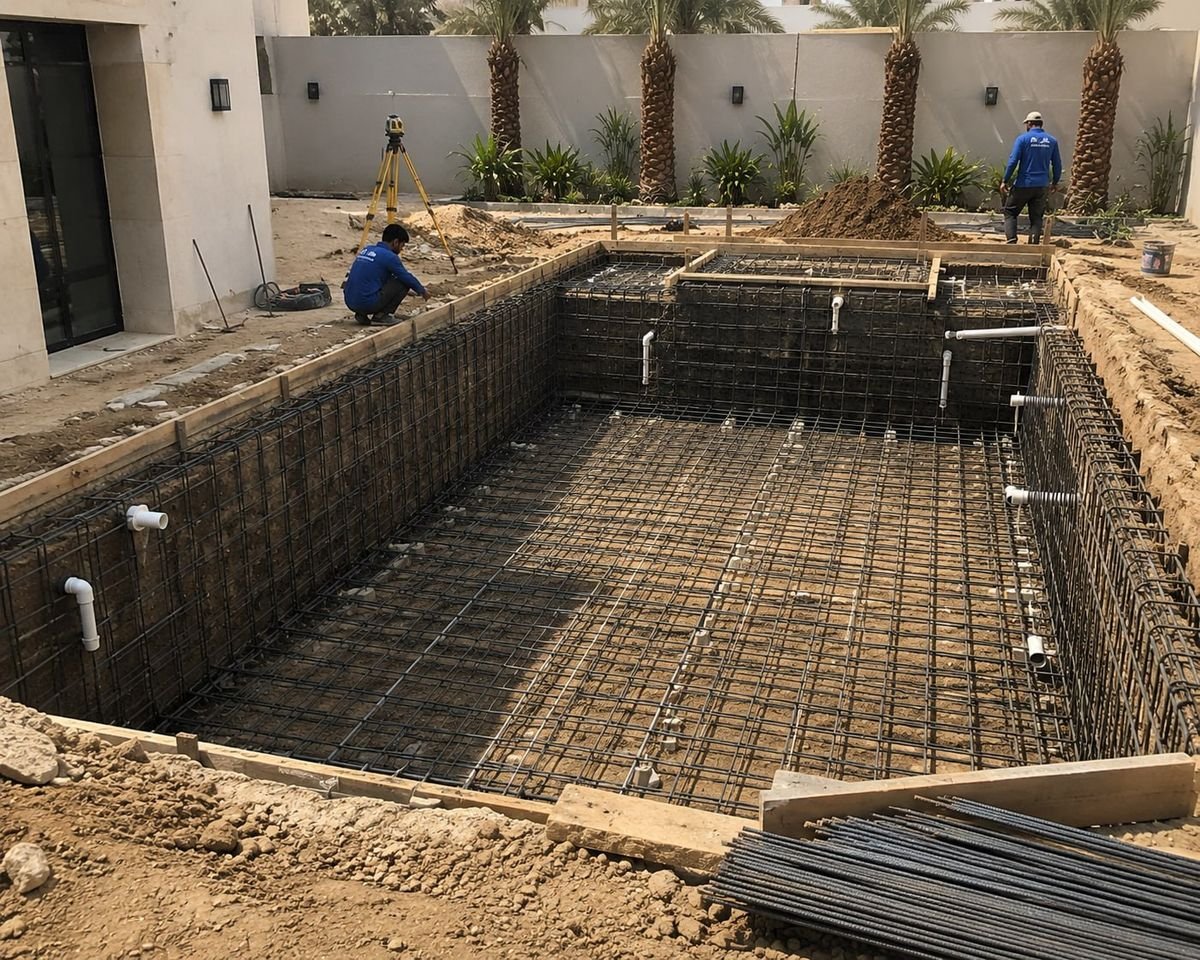
- Removing tiles and weak layers down to sound concrete.
- Treating cracks and concrete, including exposed or corroded reinforcement.
- Preparing the surface by cleaning and dampening as the product requires.
- Reinforcing corners and fittings with tapes or extra layers.
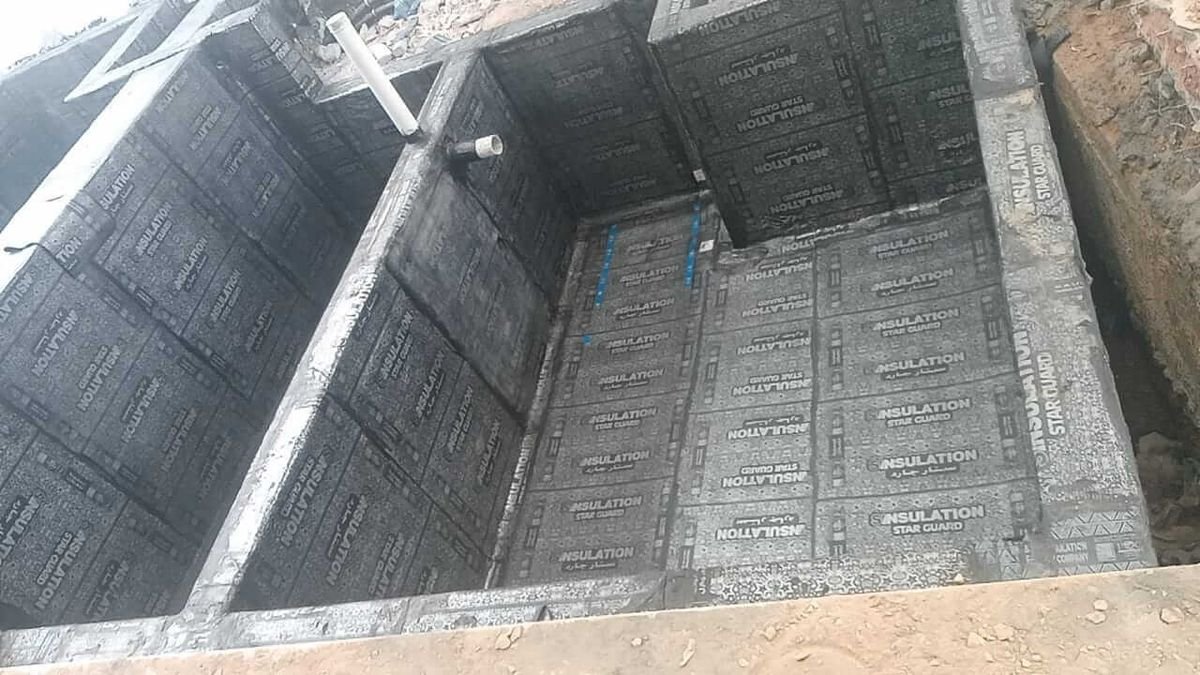
- Applying the membrane in the required number of coats and thickness, with curing time between coats.
- A fill test where possible before tiling.
- Tiling with adhesive and grout compatible with the system.
Waterproofing materials for Riyadh's climate
- Flexible cementitious membranes, common in pools because they bond well to concrete, tolerate slight movement and accept tiles.
- Crystalline waterproofing that reacts within the concrete to seal pores, often combined with other systems.
- Polymer and polyurethane systems for cases needing higher flexibility, provided they suit the adhesive and tiles.
- Reinforcing tapes for corners, movement joints and fittings.
In Riyadh's heat the system must be flexible enough for expansion and contraction and resistant to long-term chlorine exposure, applied in cooler hours and shaded while curing. Read more in our guide to pool waterproofing materials.
Protecting the pool from repeat leaks
- Keep the water level steady and avoid long empty periods.
- Balance the water, with pH around 7.2 to 7.6 to limit attack on grout and layers.
- Check grout and joints before and after summer.
- Monitor the level regularly to catch losses early.
- Use a maintenance contract covering equipment and joints.
YAM Pools starts with a free site visit and full inspection, recommends local or full treatment as the case requires, and provides a written quotation and engineering supervision, with a written warranty on workmanship and waterproofing. We serve Riyadh and all Saudi cities.
- Old pools need a full inspection, not just a sealed crack.
- Local waterproofing works only when the rest is sound.
- Full waterproofing starts at the concrete, not the tiles.
- Choose a flexible, chlorine-resistant, heat-suited system.
- Check the pipes at the same stage.
Frequently asked questions
Can a pool be waterproofed without removing tiles?
Some surface-applied solutions exist for limited cases, but they do not suit old pools with hollow tiles or concrete cracks. Real waterproofing needs access to the concrete.
How do I know my pool needs full waterproofing?
When hollow tiles are widespread, cracks appear in several walls, or past repairs have failed more than once. An on-site inspection confirms it.
Does full waterproofing mean replacing pipes?
Not always, but it is the right moment to inspect them. Old or damaged pipes are best replaced at the same stage.
Do you offer a warranty on waterproofing?
Yes. We provide a written warranty on workmanship and waterproofing stating what it covers, after inspecting the pool and agreeing the solution.