In this article
A pool in Riyadh lives in conditions unlike those of a coastal or temperate city. There is a long, hot summer, a clear gap between day and night temperatures in some months, dry air that drives evaporation, fine dust, and soil that changes from one district to the next. Each factor stresses the pool differently, and over time that stress can become a leak.
This article focuses on causes linked to the Riyadh environment and then gives an ordered method for finding the source in your pool before any repair starts. The same causes apply to many cities in central and northern Saudi Arabia with a similar climate.
The effect of a hot, dry climate
Thermal expansion and contraction
Concrete, tiles and waterproofing all expand in heat and shrink as they cool, each at a different rate. Repeated daily over years, this movement tires the junctions between materials: grout, tile edges and sealant around fittings. The upper wall and coping suffer most because they face sun and air directly.
High evaporation and changing levels
Dry air raises evaporation, so the water level keeps changing. A band of waterline tile is wetted and dried repeatedly, salts build up and grout is stressed. Frequent top-ups with fresh water also shift water chemistry and raise hardness.
Sun on exposed materials
Exposed pipes in the plant room or on a roof, rubber seals and some visible waterproofing are affected by UV and harden and crack. In Riyadh we often see more leaks at exposed joints than at buried ones.
Soil types and their effect
- Sandy soil: if not compacted well it can settle gradually, and leaking water can wash it away, leaving voids under the pool.
- Clay soil: swells when wet and shrinks when dry, pressing on the concrete from outside and opening cracks.
- Calcareous soil or fill: some plots include uneven fill, so one part of the pool settles more than another.
- Shallow rock: usually a stable base, but irregular excavation can leave uneven bearing points.
Ageing waterproofing and sealants
Waterproofing does not stay equally effective forever. How quickly it ages depends on its type, application quality and water conditions. Pools built with rigid traditional waterproofing tend to crack as the concrete moves, because those materials do not tolerate expansion. Sealants around fittings and grout also lose flexibility with heat and chlorine and pull away from surfaces.
Water chemistry matters too. Persistently low pH slowly dissolves cement grout, and very hard water leaves deposits that stress surfaces. Keeping pH roughly between 7.2 and 7.6 extends the life of these materials.
Construction errors that surface later
- Soil not compacted or treated before pouring.
- Walls and floor poured in stages without treating construction joints.
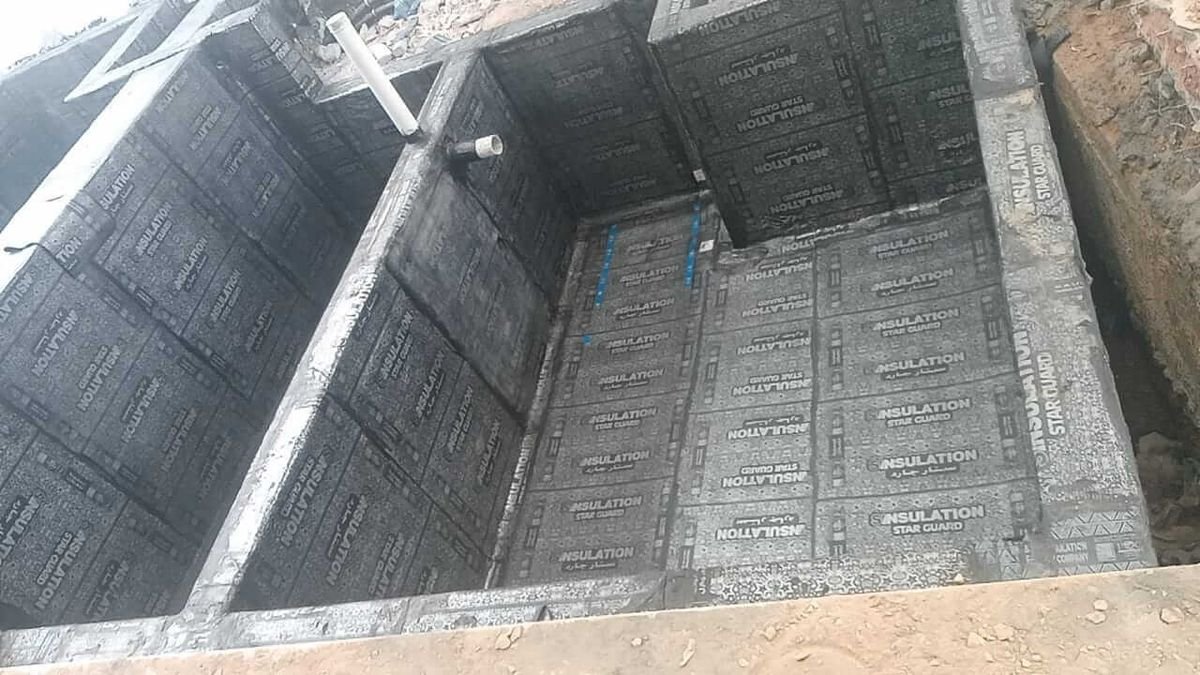
- Waterproofing applied to a damp or dirty surface, or as a single thin coat.
- No reinforcement of waterproofing at corners and fittings, the weakest points.
- Pipes laid without proper falls or with fittings not rated for burial.
- No fill test after waterproofing and before tiling.
These errors rarely show in the first year. They appear after many heat cycles and soil movement, which is why some owners think the leak came out of nowhere.
An ordered method to find the source
- Confirm it is a leak, not evaporation: a bucket test compares pool loss with a bucket on the step under the same conditions. In Riyadh dry air, evaporation alone can be noticeable.
- Compare pump on and off: if loss increases with the pump running, suspect pressure lines after the pump. If it increases with the pump off, suction lines are possible.
- Watch where the level stops: at a fitting or crack suggests the wall. If it keeps falling, the floor or drain is likely.
- Check the plant room for drips or damp around the pump, filter and valves.
- Dye-test fittings near lights, returns, skimmers and the drain.
- Call for specialist detection if still unclear: pipe pressure tests, listening devices and cameras.
For details of each test, see the bucket test and other leak detection methods.
Diagnosis with YAM Pools
YAM Pools treats a leak as a question that needs a precise answer before any work. We begin with a site visit, run the tests that suit your pool, then write down the source and repair method in a clear quotation, with a written warranty on workmanship and waterproofing. We serve Riyadh and all cities of Saudi Arabia.
Frequently asked questions
Does summer heat alone cause leaks?
Usually not directly, but heat stresses grout, seals and exposed materials and reveals existing weak points. That is why leaks are often noticed in summer.
How do I know what soil is under my pool?
Building drawings may show it, or you can watch how surrounding paving behaves. Repeated settlement or cracks call for a technical site assessment.
Can new pools leak?
Yes, if waterproofing or fittings were poorly done or no fill test was carried out before tiling. Such leaks usually show early and are easier to trace to construction.
What is the first step if I suspect a leak?
Run a bucket test for several days, comparing pump on and off. These results help the technician narrow the search quickly.