In this article
When villa owners hear about thermal insulation for a pool, many picture a layer that keeps the water cool all summer. The reality is more specific. Thermal insulation slows heat transfer between the water, the concrete shell and its surroundings, and its value depends heavily on where the pool sits and how it is built. In some cases it is essential. In others it adds cost with limited benefit. This article explains how heat moves in a pool, when insulation really helps, where it should be placed and how it differs from waterproofing, which people often confuse with it.
How heat enters and leaves a pool
- The water surface is by far the biggest path. Sun heats the water from above, and evaporation from the surface is the main way water loses heat.
- Walls and floor: for an in-ground pool, the surrounding soil has a steadier temperature than the air, so heat transfer here is slower and smaller.
- Exposed structure: if the pool is raised or on a roof, its walls and floor face hot air or direct sun, and heat transfer through them becomes significant.
- Surrounding decks store solar heat and warm the water that splashes back from them.
So insulation under the tiles of a buried pool will not, on its own, fix warm water, because most heat arrives from above.
When thermal insulation genuinely helps
Rooftop and upper-floor pools
This is the key case. The pool floor sits on a building slab and the walls may face the sun. Insulation protects the pool from hot exposed walls, protects the rooms below from heat and cold transfer, and reduces condensation on the ceiling beneath.
Pools above basements or occupied rooms
If a room, basement or garage is under or next to the pool, insulation limits heat transfer and condensation on shared walls.
Partly raised pools
Walls that rise noticeably above the yard, especially west-facing ones, benefit from external insulation.
Heated pools in winter
If you heat the water in winter, insulation cuts the heat lost through walls and floor, so the heater runs less.
Where the insulation layer goes
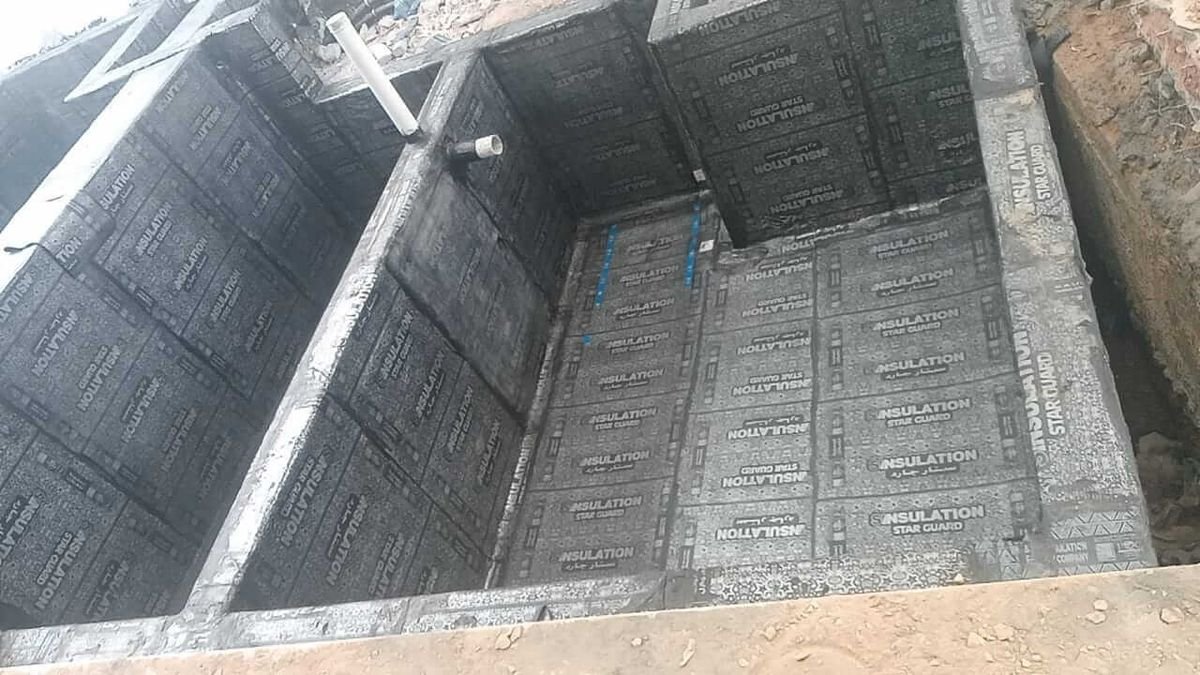
- Outside the shell: on exposed walls, insulation is fixed to the outer face of the concrete with protection from sun and impact. This does not interfere with the finishes inside the pool.
- Below the structural slab: for rooftop pools, high-density boards rated for compression are placed between the building slab and the pool or within the roof build-up, according to the structural design.
- Directly under the tiles inside the pool: this needs care, because a soft layer right behind the tiles can weaken adhesion under water pressure. If the designer chooses it, the materials must be compatible and designed for this use, with a suitable bonding layer.
Common materials
| Material | Strengths | Notes |
|---|---|---|
| Extruded polystyrene boards | Low water absorption, good compressive strength | Most common under slabs and on external walls |
| Polyurethane foam | Continuous, joint-free coverage | Needs UV protection and specialist application |
| Lightweight insulating concrete | Used as a screed and insulation on roofs | Lower insulation than boards but useful on roofs |
| Pool covers | Reduce evaporation and surface heat loss | More useful for winter heating than summer cooling |
Ordinary white expanded polystyrene that soaks up water is not suitable in damp locations, so check the board type.
Hot coping and decks: the problem people feel
In Riyadh, the most common complaint is not wall heat reaching the water but coping and decks that burn bare feet. The answers are light-coloured coping and paths, insulation under raised or rooftop decks to reduce stored heat, and partial shade over seating areas.
If your goal is cooler water in summer
Insulation alone is not enough for a buried pool. The most effective measures start at the surface: shade part of the pool, run filtration at night, add a waterfall to increase evaporation, and for daily use consider a pool chiller sized after a site visit. To see which materials make the heat problem worse, read material mistakes in hot climates.
Decision summary
- Rooftop pool or pool above rooms: insulation is essential and designed with the structure.
- Pool with exposed walls above ground: external wall insulation helps.
- Fully buried pool: prioritise waterproofing, shade and light coping.
- Heated pool in winter: insulation reduces heating energy.
- In every case: never break the continuity of waterproofing for insulation.
Frequently asked questions
Will thermal insulation keep my pool water cool in summer?
In a buried pool its effect is limited, because most heat comes from sun on the water surface. Shade, night circulation and a chiller where needed make a bigger difference.
Does a rooftop pool need thermal insulation?
Usually yes. It shields the pool from exposed walls and protects rooms below from heat transfer and condensation, and it should be designed with the structure.
What is the difference between thermal insulation and waterproofing?
Waterproofing stops water escaping from the pool, while thermal insulation slows heat transfer. Every pool needs waterproofing, while thermal insulation depends on location and design.
Can I add insulation to an existing pool?
It can be added to exposed walls from outside or under surrounding decks during renovation. Adding it inside the pool under tiles needs study because it affects the finish and waterproofing layers.