
In this article
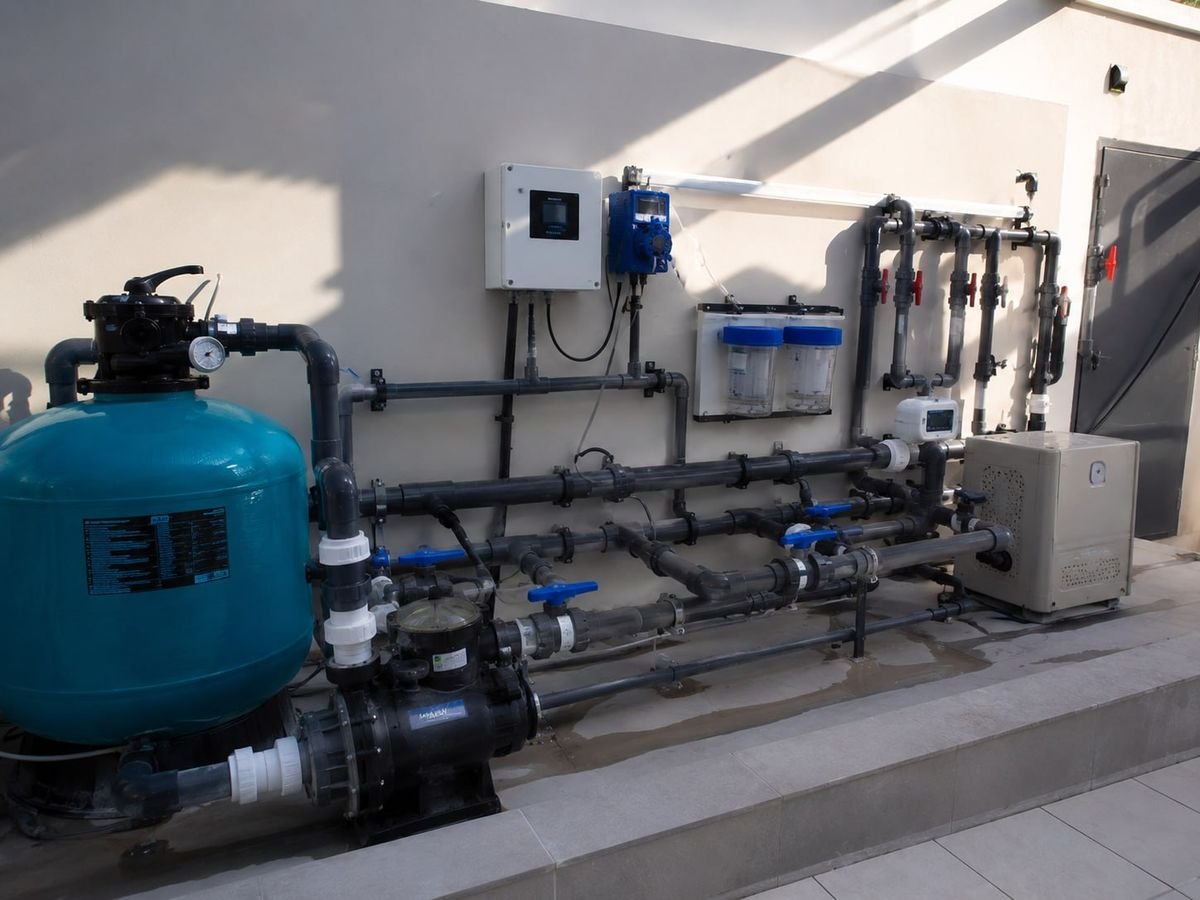
The pump and filter are the heart and lungs of a pool. The pump moves the water and the filter traps dirt and returns it clean. When they work, nobody notices them. When they struggle, everything changes: the water clouds, chlorine is not enough, algae appears and the electricity bill rises. The plant room is usually tucked away in a corner of the yard, so nobody visits until something obviously fails. In a Riyadh summer the equipment runs for long hours in high heat with constant dust, so neglect affects it faster than in milder places. This article focuses on the pump and filter: how damage develops, the early warning signs and the routine that protects them.
How the pair work together
Water enters the pump through the suction line after passing the hair and leaf basket. The pump pushes it to the filter, which traps particles, and clean water returns to the pool. Any blockage raises the load on the pump:
- A full skimmer or pump basket starves the pump of water.
- A clogged filter raises the pressure the pump must overcome.
- Air drawn in through a loose joint makes the pump run half empty.
The result is always the same: less flow, a hotter motor, more electricity and dirtier water.
What neglect does to the pump
Running dry
The most harmful condition. When the water level drops below the skimmer opening or baskets clog, the pump starts drawing air. Water cools the mechanical seal and impeller, and without it the seal overheats and fails, and plastic parts of the housing can deform. In Riyadh, high evaporation lowers the level quickly, so watching it is part of protecting the pump.
Seal failure and leaks
The mechanical seal keeps water away from the motor. Heat, unbalanced water and dry running wear it out, and a drip appears under the pump. That drip matters, because water reaching the motor bearings destroys them.
Bearing failure
A loud screech or grinding usually means worn bearings, often from water leaking past the seal or long service without maintenance. Left alone, it leads to motor failure.
Motor overheating
A motor in a hot, closed room, working against a clogged filter without ventilation, runs hot constantly. Heat breaks down winding insulation until the motor burns out.
Impeller blockage
Hair, leaves and small stones escaping a broken basket reach the impeller, clogging it or breaking its vanes, and flow drops noticeably.
What neglect does to the filter
- Sand filters: without regular backwashing, sand clumps and forms channels that let water pass unfiltered, so pressure can look normal while water stays cloudy. Eventually the sand needs replacing.
- Cartridge filters: dust and oils block the fabric. Uncleaned cartridges tear or collapse.
- The multiport valve: its internal gasket wears and water leaks to waste even in filter mode.
- The filter body: if it sits in the sun unprotected, plastic weakens and cracks under heat and pressure.
- The pressure gauge: a broken gauge leaves you working blind, with no idea when to clean.
Warning signs before a major failure
| Sign | Likely cause |
|---|---|
| Screeching or grinding | Worn bearings |
| Bubbles at return jets | Air entering the suction side or pump lid |
| Drip under the pump | Failed mechanical seal |
| Filter pressure higher than usual | Filter needs cleaning or sand has clumped |
| Pressure lower than usual | Suction blockage or full baskets |
| Motor very hot to touch | Excess load or poor ventilation |
| Breaker trips | Electrical problem or worn motor, needs a technician |
| Cloudy water despite long running | Poor filtration or damaged media |
A routine that protects the heart
- Weekly: empty skimmer and pump baskets and check that the pump lid and its O-ring seal properly.
- Weekly: watch the water level and keep it around the middle of the skimmer opening.
- By the gauge: backwash and rinse a sand filter, or remove and hose down a cartridge.
- Monthly: check the pump and joints for drips, listen to the motor and feel its housing.
- Periodically: deep-clean cartridges with a degreasing cleaner and check sand condition.
- Before summer: a full technical check of pump, filter, valves and electrics.
- Always: ventilate the plant room and keep chemicals away from it.
Repair or replace?
Many faults are fixed with simple parts: a seal, bearings, a lid or an O-ring. Early repair keeps a pump going for years more. Replacement makes more sense when the motor has burned out, the housing is cracked, the pump is the wrong size for the pool, or it is so old that parts are unavailable. It is often worth considering a variable-speed pump, which can run at low speed most of the time with lower energy use and noise. For a cost comparison, read repairing a neglected pump versus regular maintenance.
Summary
- Never let the pump run without enough water.
- The filter pressure gauge is your most useful tool.
- Drips, noise and heat are early signs. Do not ignore them.
- Riyadh dust fills filters quickly, so clean more in dusty seasons.
- A small repair on time saves a full replacement.
Frequently asked questions
Why is my pool pump so loud?
Common causes are worn bearings, air entering the suction line or debris in the impeller. Persistent noise needs checking before it leads to motor failure.
How do I know when the filter needs cleaning?
From the pressure gauge. When the reading rises clearly above the clean-filter reading, it is time to backwash or clean the cartridge.
What happens if the pump runs dry?
The mechanical seal overheats and fails quickly, and the housing can deform. Keep the water level adequate and the baskets clear.
Is water under the pump normal?
No. A drip usually means a failed seal, and water reaching the bearings and motor causes a bigger failure. Fix it quickly.