In this article
The first thing many owners notice in a neglected pool is not the water. It is a brown streak under the ladder, rust spots on the handrail or an orange halo around a light. Some treat it as cosmetic and reach for a strong cleaner, but rust in a pool can point to something deeper: unbalanced water, a metal of the wrong grade or corrosion in a buried anchor you cannot see. In the worst cases, rust weakens fixings until the ladder moves as you climb. This article explains how to assess rust in an existing pool, when cleaning is enough, when replacement is needed and how to stop it coming back.
Where rust appears
- Ladders and handrails, especially at welds and where they enter the coping, since water collects there.
- Buried anchors: rust here stays hidden until it reaches the surface or the ladder loosens.
- Light rings and screws: always submerged, and a cheap screw rusts and marks the tiles.
- Metal drain covers and any metal parts on the floor.
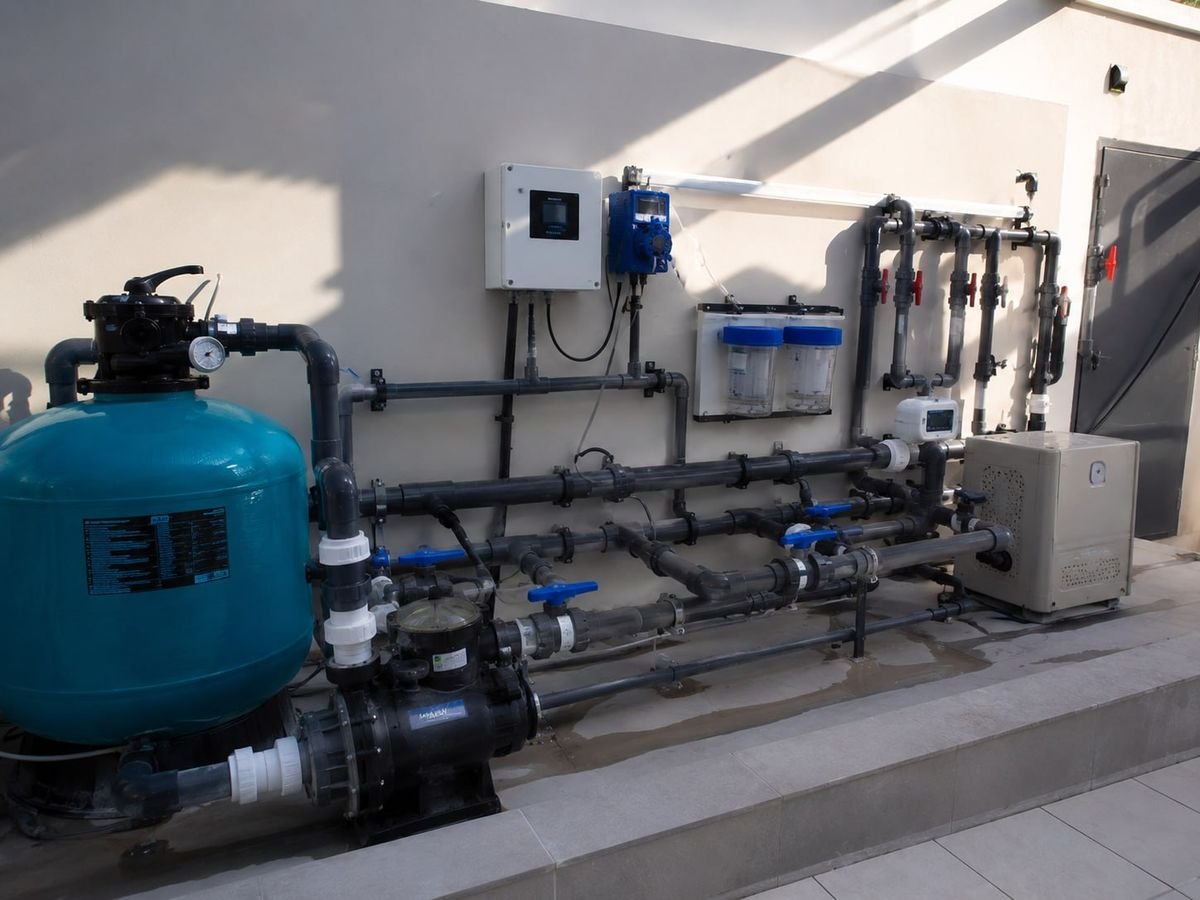
- In the plant room: metal pump bodies, clamps, valves and internal parts of heaters or chillers.
- Reinforcing steel: rust stains coming through the concrete itself are the most serious kind, meaning water has reached the steel.
Why neglect speeds up rust
- Acidic water: when pH drops below the normal range of about 7.2 to 7.6, water becomes aggressive towards metals.
- Concentrated chlorine: tablets or granules dropped near a ladder or left in the skimmer create a high-concentration zone that attacks nearby metal.
- Salt build-up: parts above the water are splashed and dried in the sun, layering salt that is never rinsed off.
- Electrical corrosion: poor bonding or dissimilar metals in contact speed up corrosion in one of them.
- No cleaning: a small spot left alone deepens into a pit that is hard to remove.
How serious is it?
| Level | What it looks like | Action |
|---|---|---|
| Surface | Light brown marks that wipe off, leaving a smooth surface | Clean, treat the surface, balance the water |
| Moderate | Small pits where marks return after cleaning, or rust at welds | Specialist treatment and monitoring, replace if it recurs |
| Serious | Loss of thickness, a moving ladder, or rust coming through concrete | Stop use, inspect, replace or carry out structural repair |
Treatment by level
Surface rust
- Balance the water first, or the rust will return.
- Clean with a stainless cleaner and a soft cloth. Avoid steel wool, which leaves iron particles that rust.
- Rinse with fresh water and dry.
- Treat tile stains under the fitting with a cleaner suited to the tile.
Moderate rust
A technician should check whether the part was the wrong grade from the start. If so, repeated cleaning will not solve it, and replacement with a chloride-resistant grade such as 316 is better.
Serious rust
Replace the part and inspect the buried anchor. Sometimes the anchor itself is corroded and part of the coping must be opened to fit a new, sealed anchor. Rust coming through concrete needs an engineering inspection because it signals a leak reaching the reinforcement. Read more in concrete pool structure damage.
If you replace, replace properly
- Choose pool-grade stainless steel with a polished finish.
- Use screws and anchors of the same metal.
- Seal the anchor against water ingress.
- Have bonding and earthing checked by a qualified technician.
- Clean the fitting after installation to remove iron particles from cutting tools.
Prevention that keeps rust away
- Keep pH in the normal range and test regularly.
- Do not drop concentrated chlorine near metal. Use a feeder or dissolve it as instructed.
- Rinse ladders and rails with fresh water now and then, especially in summer.
- Wipe spots as soon as they appear.
- Ventilate the plant room and keep chlorine away from pumps and metal valves.
- Include metal fittings in the periodic checks of your maintenance contract.
Summary
- Rust is a signal, not just a cosmetic issue.
- Judge the level: surface, moderate or serious.
- Any movement in a ladder means stop using it and inspect.
- Rust from concrete needs an engineering inspection.
- Balanced water and the right metal are the real prevention.
Frequently asked questions
Is rust on the ladder dangerous or just cosmetic?
If it is on the surface and wipes off, it is usually cosmetic and needs water balancing and cleaning. If the ladder moves or has visible thinning, it is a safety hazard that needs immediate inspection.
Why does rust come back after I clean it?
Because the cause is still there, such as acidic water, the wrong metal grade or embedded iron particles. Fix the cause or it will return.
Can I use steel wool to remove rust?
No. Steel wool leaves iron particles that rust later and create new stains. Use a specialist cleaner and a soft cloth.
What do rust stains coming from the pool wall mean?
Usually that water has reached the reinforcing steel inside the concrete through a leak or weak waterproofing. That needs an engineering inspection.