
In this article
- What a waterfall or fountain adds
- Waterfall types
- Fountain types
- Choosing between them
- Pumps and plumbing
- Water loss and chemistry
- Does a waterfall cool the pool?
- Lighting
- Materials that last
- Adding a waterfall to an existing pool
- Where to place it
- Care and common mistakes
- What drives the cost
- Frequently asked questions
The sound of water falling into a pool changes the whole yard. It masks street noise, gives the surface movement and draws the eye of everyone sitting around it. That is why a pool with a waterfall is one of the most requested features in new villas and renovations. A waterfall is not a decorative piece you bolt on, though. It becomes part of the water system and affects circulation, chemistry, electrics and even how much water you lose. This guide covers the main waterfall and fountain types and how to choose the right one for your pool.
What a waterfall or fountain adds
- Sound that calms the space and covers background noise.
- Movement on a surface that would otherwise sit still.
- A focal point, especially at night with lighting.
- Some cooling, since spraying water raises evaporation. The effect has limits, explained below.
- Better circulation in dead corners when placed well.
Waterfall types
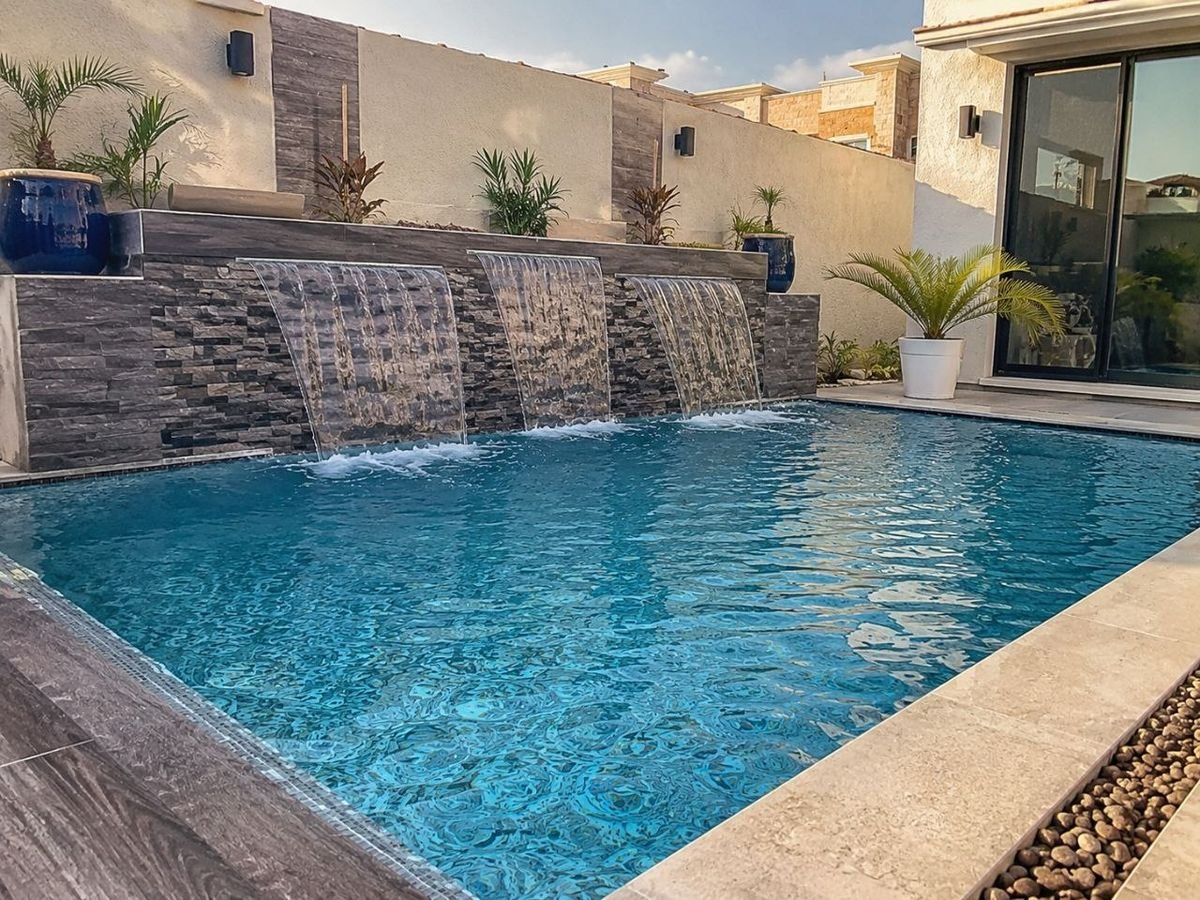
Sheer descent. A long narrow stainless outlet that releases a smooth, clear sheet of water from a raised wall or seat edge. It looks clean and modern. Flow must be set precisely, since too little breaks the sheet and too much makes it splash. Hard water leaves scale on the lip that spoils the sheet unless cleaned.
Water wall. Stone, tile or mosaic with water running down its face. Quieter than a sheer descent, with less splash. It suits pools beside a boundary wall and doubles as a privacy screen.
Rock waterfall. Natural or cast rocks with water flowing over several levels. It suits large gardens and needs careful design for weight, fixing and waterproofing underneath, or water seeps into the soil instead of returning to the pool.
Rain curtain. A row of small outlets in a pergola or bridge above part of the pool, releasing water like rain. Striking with lighting, but it needs a structure overhead and it loses the most water to wind.
Spillover from a raised spa. A jacuzzi set higher than the pool spills into it, giving a natural waterfall with no extra feature.
Infinity edge. In an infinity pool water spills over one edge into a catch channel, so the pool seems to have no end. It needs structural design, a balance tank and a dedicated pump, planned with the build.
Fountain types
- Deck jets. Small nozzles in the surrounding deck that arc water into the pool. Children love them.
- Bubblers. Nozzles in a shallow ledge that push water up a short height, ideal for in water seating.
- Laminar jets. Smooth glass like arcs of water that look dramatic at night.
- Scuppers and bowls. Spouts in a wall or bowls on the coping that pour into the pool, with a classic or Arabic feel depending on design.
Choosing between them
| Question | What it means |
|---|---|
| How much space is there? | Rock falls and rain curtains need room. Sheer descents and scuppers suit tight spaces. |
| Loud or quiet? | Sheer descents and rain are loudest. Water walls and bubblers are quietest. |
| Windy spot? | Anything that throws water into the air loses more in wind. |
| Young children? | Deck jets and bubblers are fun and safe with slip resistant decking. |
| Hard water? | Sheer descents and laminar jets scale faster and need regular cleaning. |
| New or existing pool? | Infinity edges and built walls are planned with construction. Scuppers and deck jets are easier to add later. |
Pumps and plumbing
Most waterfalls need a pump separate from filtration, because a waterfall wants a set flow at a set pressure. Small features can run off the filter return with a control valve, but that reduces water returning to the pool and weakens filtration. Pump size depends on the width, height and type of feature and the length of pipe. Guessing gives either a broken sheet or an oversized pump wasting power. A variable speed pump lets you tune the flow exactly. Lines must be protected under the deck, with an isolation valve so the feature can be serviced without stopping the pool. We plan this with our filters and pumps team.
Water loss and chemistry
Water thrown into the air partly evaporates, and in summer heat and wind the loss can be noticeable. It is not a leak, but you will top up more often. If the level drops faster than you expect, our leak detection team can confirm whether it is evaporation or a real leak. Evaporation also concentrates calcium in the remaining water, raising hardness and leaving white scale on stone and metal. Strong aeration drives off carbon dioxide and pushes pH up faster, so a pool with a waterfall needs closer pH and alkalinity checks.
Does a waterfall cool the pool?
A little. Evaporation pulls heat out of the water, and the effect is clearer at night in dry air. Under direct midday sun, a waterfall alone will not cool a whole pool.
Lighting
Without lighting a waterfall disappears at night, which is when most families use the pool for much of the year. A light under a sheer descent makes the sheet glow, uplighting brings out stone texture, and colour lights suit occasions. All lighting near water is low voltage with proper protection, and it belongs in the plan with the feature, not after it. This is part of our lighting and electrical work.
Materials that last
Stainless steel must be a grade that resists chlorine or it rusts quickly. Stone should be low porosity so it does not absorb water and crack. Adhesives and grout must be rated for submerged areas.
Adding a waterfall to an existing pool
Scuppers, deck jets and a separate water wall beside the pool are the easiest additions. They need new lines, a pump and a place for it, and wiring. An infinity edge or a changed pool edge is major structural work close to a full renovation. If your pool needs renovating anyway, that is the best moment to add a feature, since breaking out and plumbing happen once. Our pool renovation service includes these additions.
Where to place it
Put the feature in the line of sight of the main seating, since a waterfall nobody sees from the majlis or the outdoor lounge adds little. Keep it away from the usual wind direction, which carries spray onto the seating and breaks the sheet. Placing it opposite the skimmer pushes the surface toward it and helps pull leaves and dust in. Keep falling water away from steps and diving areas, because it hides the view below the surface. In winter a waterfall cools the water by exposing it to cold air, so if you heat your pool, run the feature only while you sit outside. Decking around it must be slip resistant, and tall walls should not invite children to climb or jump. A maintenance visit can include descaling the feature and checking its pump.
Care and common mistakes
Descale outlets regularly with non abrasive products, check the feature pump basket, watch pH and hardness, and run the feature on a timer rather than all day. Common mistakes include choosing from a photo without calculating flow, running the feature off the filtration line, placing it where it splashes the seating, forgetting lighting until after tiling, using ordinary stainless that rusts, and weak waterproofing under rockwork.
What drives the cost
Type, width, height, material, pump size, pipe runs, lighting and whether the pool is new or existing all shape the price. After a visit we provide a written quote listing each item. See our projects for ideas, read about pool types on our pool construction page, and contact us to choose the right feature for your pool.
Frequently asked questions
Does a waterfall need its own pump?
Most do. Small features can run off the return line, but that weakens filtration and limits the effect.
Does a waterfall increase water use?
It raises evaporation, especially in heat and wind, so you top up more. Running it on a timer reduces the loss.
Can I add a waterfall to an old pool?
Yes for most types, such as scuppers, water walls and deck jets. An infinity edge is major structural work.
Will a waterfall cool my pool?
Only a little, mostly at night. It is not enough on its own in peak summer sun.
Which waterfall is the quietest?
A water wall where water runs down the face, and bubblers in a shallow ledge. Sheer descents and rain curtains are louder.